Outsourcing Software Development: Pros and Cons [2026 Analysis]
iTenX Team7 min read
Business
Every engineering leader eventually faces the build-vs-buy question—except in 2026, it's really a build-here vs. build-there question. Understanding the outsourcing software development pros and cons before you sign a contract is what separates companies that scale fast from companies that spend 18 months untangling a vendor relationship that never worked. This guide gives you an honest, data-backed breakdown so you can make the right call for your product, your team, and your budget.
The Core Pros of Outsourcing Software Development
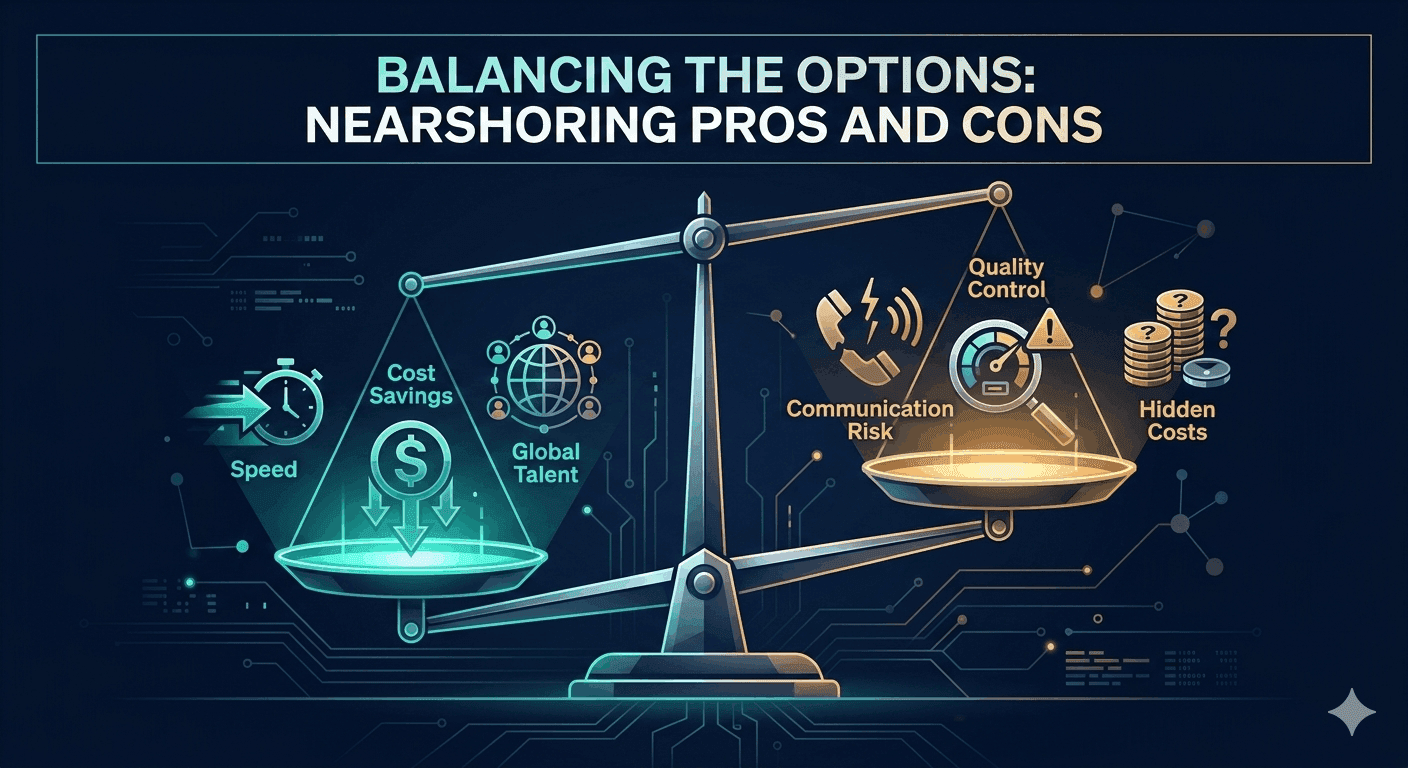
Outsourcing software development delivers three compounding advantages: lower labor costs, faster access to specialized talent, and the ability to scale headcount without the overhead of full-time employment. According to a Deloitte Global Outsourcing Survey, 70% of companies cite cost reduction as a primary driver for outsourcing—but the leaders who get the most value treat it as a capability strategy, not just a savings play.
Cost Efficiency That Goes Beyond Hourly Rates
Senior engineers at US-based firms typically bill at $150–200 per hour when you factor in salary, benefits, payroll taxes, and recruiting costs. Nearshore developers in Latin America typically cost 55–65% less than equivalent US talent, with senior engineers available at $45–85 per hour through partners like iTenX—without sacrificing code quality or communication standards. That delta funds entire product roadmaps.

Access to a Deeper Talent Pool
The US tech labor market remains structurally constrained. According to the Stack Overflow Developer Survey 2024, demand for full-stack, mobile, and AI/ML engineers continues to outpace domestic supply in North America. Outsourcing opens access to strong engineering communities in Colombia, Mexico, Argentina, and Brazil—markets producing tens of thousands of computer science graduates annually who are increasingly fluent in agile, cloud-native, and modern DevOps practices.
Speed to Hire and Elastic Scaling
A US hiring cycle for a senior engineer averages 45–60 days from job post to offer acceptance, and another 2–4 weeks before the engineer is productive. Companies that switch to nearshore development report an average 40% reduction in time-to-hire. For a startup racing to hit a Series A milestone or a mid-market SaaS team launching a new module, that gap in velocity is the difference between shipping on time and missing the window.
The Real Cons of Outsourcing Software Development
The cons of outsourcing software development are real, but most of them are management problems, not outsourcing problems. Knowing where failure typically lives lets you structure the engagement to avoid it.
Communication Gaps and Timezone Friction
Offshore outsourcing pros often go unnoticed because the model gets blamed for problems that are really symptoms of a 10–14 hour timezone gap. When a blocker sits unresolved overnight because no one is awake to answer it, sprint velocity drops and frustration builds. This is one reason why nearshore development—with teams in the same or adjacent timezones to the US—has grown significantly as an alternative to pure offshore models. For a deeper look at how the two models compare, see Nearshore vs. Offshore Development: A Complete Guide.
Quality Control and Knowledge Transfer Risk
Outsourcing creates institutional knowledge risk if it isn't actively managed. When a vendor team rolls off, tribal knowledge about architecture decisions, API quirks, and business logic can walk out the door with them. The fix is structural: enforce documentation standards from day one, require code reviews that include your internal engineers, and treat onboarding as a two-way process. Companies that skip this step often rediscover it painfully at renewal time.
Hidden Costs and Misaligned Incentives
Fixed-bid contracts can create perverse incentives—vendors optimize for scope completion, not product quality. Time-and-materials arrangements solve this but require stronger internal oversight. Budget for a part-time technical program manager or a senior internal engineer who owns the vendor relationship. The overhead feels expensive until you compare it to the cost of a six-month project that gets delivered late, over budget, and full of technical debt.
Pros and Cons of Outsourcing Overseas: A Decision Framework
Before evaluating vendors, run your project through this five-question framework. It will surface whether outsourcing is the right move and which model—offshore, nearshore, or hybrid—fits your situation.

1. What is the timezone overlap requirement? If your team runs daily standups and needs real-time problem-solving, nearshore (1–3 hour offset) is safer than offshore (8–12 hour offset). 2. How mature is your internal technical leadership? Outsourcing works best when you have at least one senior internal engineer who can own code quality and architectural direction. 3. Is the project greenfield or brownfield? New builds with clean specs are far easier to hand off than legacy codebases with undocumented logic. 4. What is the expected engagement length? Short-burst projects (under 6 months) favor fixed-bid offshore. Long-term product development favors embedded nearshore teams. 5. Do you have IP or compliance sensitivity? If yes, prioritize vendors with SOC 2 practices, clear IP assignment clauses, and data residency controls from the contract stage.
If your answers point toward long-term, collaborative product development, an agile nearshore development model will outperform a traditional offshore vendor arrangement in most cases.
Real-World Example: How a VC-Backed Fintech Scaled Engineering Without Blowing the Runway
A Series B fintech startup based in Austin needed to build a compliance reporting module in 90 days—a timeline their three-person internal engineering team couldn't hit alone. Hiring onshore contractors would have cost approximately $180–220 per hour per engineer, which would have consumed a significant portion of their remaining runway before the feature could generate revenue.
Instead, they embedded a nearshore team of four engineers and a QA specialist operating on Central Time—the same timezone as their Austin office. Daily standups ran at 9 AM with no scheduling gymnastics. The compliance module shipped in 87 days, code was fully documented and transitioned to the internal team at handoff, and the cost came in at roughly 58% of what onshore contractors would have billed. The CTO later noted that the real advantage wasn't the price—it was the zero-latency communication that kept the project moving without the overnight blockers they'd experienced with a previous offshore engagement.
If you're evaluating how to structure a team like this, the guide to building a nearshore development team covers the hiring criteria, contract structures, and onboarding practices that make embedded engagements work.
When Outsourcing Software Development Is — and Isn't — the Right Move
Outsourcing software development is the right move when speed, cost, and access to specialized skills are the binding constraints. It is the wrong move when the work is highly experimental, requires constant pivoting based on user feedback gathered in-house, or when your internal team lacks the technical leadership to manage an external partner. The failure mode isn't outsourcing—it's outsourcing without the internal infrastructure to make it succeed.
The strongest signal that outsourcing will work for you: you can write a clear brief, you have someone internally who will own the relationship technically, and the output is measurable. When those three conditions exist, the pros of outsourcing software development—cost, speed, and talent access—consistently outweigh the cons.
For teams evaluating broader outsourcing strategies beyond development alone, application outsourcing benefits and best practices is a useful companion read.
Ready to Weigh Your Options? iTenX Can Help
If you're still mapping the outsourcing software development pros and cons against your specific situation, the most useful next step is a conversation—not another vendor pitch deck. iTenX works with VC-backed startups and mid-market SaaS companies to build senior nearshore engineering teams in Latin America, with engineers operating in US timezones at $45–85 per hour. No middlemen, no body-shopping—just direct access to vetted senior engineers who work as an extension of your team. Reach out to talk through your project scope, and we'll tell you honestly whether we're the right fit.