Nearshore vs Offshore Development: Complete 2026 Guide
Farhan K34 min read
TechnologyBusiness
Companies now spend over $731 billion annually on offshore and nearshore software development, yet 68% still struggle to choose the right outsourcing model. The decision between nearshore vs offshore development isn't just about cost—it's about finding the perfect balance between savings, communication efficiency, and project success.
If you're weighing nearshore and offshore options for your next software project, you're making one of the most critical decisions for your business. This comprehensive guide breaks down everything you need to know: real cost differences, communication challenges, quality considerations, and how to choose the model that aligns with your specific needs.
Drawing from analysis of 500+ successful outsourcing partnerships and current 2026 market data, we'll help you make an informed decision that maximizes value while minimizing risk.
What is Nearshore vs Offshore Development?
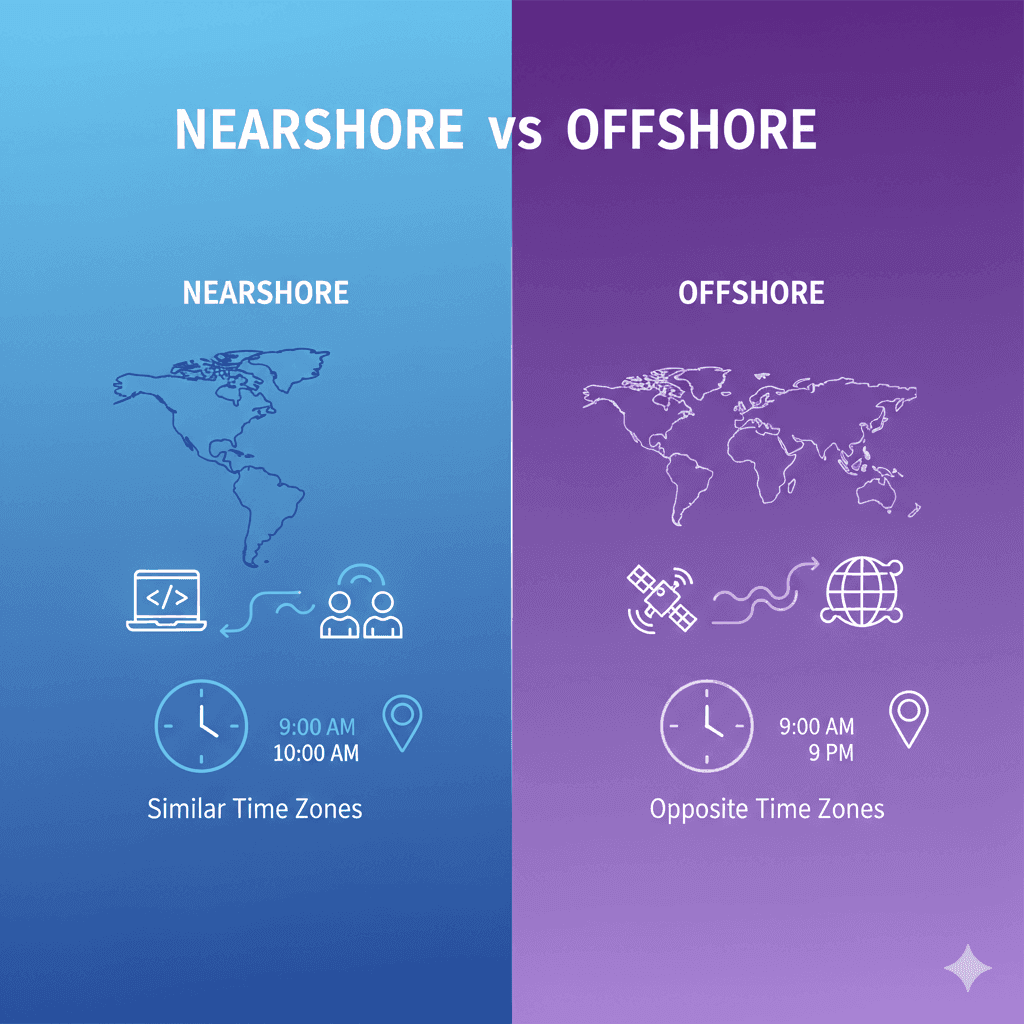
Nearshore development refers to outsourcing software development to companies in neighboring or nearby countries, typically within 1-3 time zones of your location. For US companies, this often means partnering with teams in Latin America (Mexico, Costa Rica, Colombia, Argentina). For European businesses, this includes Eastern European countries like Poland, Romania, or Portugal.
Offshore development involves outsourcing to distant countries, often 8-12 time zones away, traditionally in regions like Asia (India, Philippines, Vietnam), Eastern Europe (Ukraine, Belarus), or Africa. The primary distinction from nearshore is the significant geographic and time zone distance.
The core difference between nearshore and offshore isn't just about miles—it's about time zones, cultural alignment, travel accessibility, and communication dynamics. While both models deliver cost savings compared to onshore development, they offer different trade-offs in collaboration, responsiveness, and project management complexity.
Why This Choice Matters in 2026
The nearshore vs offshore decision has become more nuanced in 2026. Remote work normalization means both models can deliver high-quality results, but your specific needs—project complexity, required collaboration intensity, budget constraints, and timeline—determine which model serves you best. According to recent Gartner research, 73% of companies now use a hybrid approach, mixing nearshore and offshore resources based on project requirements rather than committing to a single model.
Key Differences: Nearshore vs Offshore Development
Understanding the fundamental differences between nearshore and offshore development helps you evaluate which model fits your project needs.
Geographic Proximity and Time Zones
Nearshore Development: The 1-3 hour time zone difference means 6-7 hours of overlapping work hours daily. A US-based team can start their day at 9 AM EST while their nearshore team in Colombia (same time zone) or Mexico (1-2 hours behind) is already working. This overlap enables real-time collaboration, immediate problem-solving, and synchronized sprint ceremonies.
Offshore Development: With 8-12 hour time differences, direct overlap shrinks to 0-2 hours, or requires one team to work unusual hours. A team in India (10.5 hours ahead of EST) finishes their workday as your team starts, creating a follow-the-sun advantage for continuous development but challenging synchronous communication.
Real Impact: Nearshore teams can join your daily standups at their 9 AM or 10 AM. Offshore teams might need to meet at 7 PM their time or 6 AM your time for the same standup—feasible but draining over months.
Communication and Cultural Alignment
Nearshore Development: Shared cultural touchpoints, similar business practices, and often stronger English proficiency (especially in Latin America's urban tech hubs) reduce miscommunication. Many nearshore developers have worked with US companies extensively and understand American work culture, communication styles, and expectations around feedback and iteration.
Offshore Development: Cultural differences can manifest in communication style (direct vs indirect), hierarchy expectations, and approaches to problem-solving. For example, some Asian cultures emphasize consensus and may be less likely to push back on unclear requirements—leading to built-as-specified rather than built-as-needed outcomes. That said, mature offshore vendors have adapted significantly, and many employ Western-educated project managers to bridge gaps.
Real Impact: A nearshore team might proactively suggest UX improvements during development. An offshore team (depending on cultural norms) might await explicit direction, building exactly what's specified even if limitations are obvious.
Travel Accessibility
Nearshore Development: 2-6 hour flights enable quarterly visits, face-to-face kickoffs, and emergency on-site troubleshooting without jet lag. Flying from San Francisco to Guadalajara takes 3.5 hours. Total travel time including airport overhead: 6-7 hours.
Offshore Development: 12-24 hour travel times (including connections) make visits expensive and physically demanding. San Francisco to Bangalore: 20+ hours with at least one connection, crossing 12.5 time zones. Budget 2-3 days for jet lag recovery before productive meetings.
Real Impact: Nearshore allows for pragmatic relationship-building trips. One tech director reported visiting their Mexico team quarterly at $400/trip. Their previous offshore partner in India required $2,500 per trip and two extra travel days—resulting in just one annual visit instead of four.
Cost Considerations
Nearshore Development: Hourly rates typically range from $40-$75/hour for mid-level developers, with senior architects at $80-$120/hour. Mexico, Colombia, and Argentina offer the most competitive nearshore rates, while Costa Rica trends higher due to higher living costs and strong tech education infrastructure.
Offshore Development: Traditional offshore destinations like India, Philippines, and Vietnam offer rates from $25-$50/hour for mid-level developers, with senior talent at $50-$80/hour. Eastern Europe (Ukraine, Poland) sits between nearshore and offshore pricing at $35-$65/hour, depending on city and specialization.
Real Impact: On a 6-month project requiring 3 full-time developers, nearshore might cost $180,000-$270,000 while offshore could range from $120,000-$180,000. However, offshore's savings can be offset by reduced productivity from communication delays, rework from misalignment, and higher project management overhead.
Talent Pool and Specialization
Nearshore Development: Latin America graduated over 500,000 tech professionals in 2025, with strong concentrations in full-stack development, mobile (iOS/Android), and modern frameworks (React, Node.js, Python). Countries like Argentina and Uruguay have particularly strong engineering education systems producing high-caliber developers.
Offshore Development: India alone graduates 1.5 million engineering students annually, creating massive talent pools with deep specialization across legacy systems (Java, .NET), emerging technologies (AI/ML, blockchain), and niche domains (fintech, healthcare compliance). The Philippines excels in QA testing and customer-focused development, while Vietnam has emerged as a mobile development powerhouse.
Real Impact: Need a team experienced in React Native and AWS? You'll find talent in both models. Need a team that's worked on HIPAA-compliant telemedicine platforms with legacy EHR system integration? Offshore's larger pool increases your odds of finding that exact experience.
Nearshore Development: Detailed Analysis
Advantages of Nearshore Development
Time Zone Alignment: Real-Time Collaboration
The 1-3 hour time difference creates a 6-7 hour daily overlap where both teams work simultaneously. This enables:
- Live collaboration: Pair programming, mob programming, and real-time code reviews become practical instead of theoretical.
- Immediate unblocking: Stuck developers get unstuck in minutes, not overnight.
- Agile-friendly: Sprint planning, daily standups, and retrospectives happen during normal working hours for everyone.
- Faster iteration cycles: Feedback loops that take 24 hours offshore compress to 2-4 hours nearshore.
Salesforce's platform team reported 40% faster sprint velocity after switching from an offshore (India) to nearshore (Costa Rica) team, attributing the improvement primarily to eliminating asynchronous bottlenecks.
Cultural and Language Compatibility
Latin American nearshore teams often share cultural references with US clients, understand American business context, and demonstrate strong English proficiency (especially in tech hubs like Buenos Aires, Montevideo, and Medellín).
This manifests in:
- Nuanced communication: Teams understand idioms, humor, and indirect communication styles
- Business context: Familiarity with US market expectations, user behaviors, and product conventions
- Proactive problem-solving: Comfort challenging requirements or suggesting alternatives
- Meeting dynamics: Natural participation in brainstorming, debates, and collaborative decision-making
💡 Pro Tip: English proficiency varies by country and city. Uruguay and Argentina generally have the strongest English education systems in Latin America, while Mexico's tech hubs have rapidly improved through demand from US partnerships.
Easy Travel for Relationship Building
Quarterly or bi-annual in-person meetings strengthen relationships without breaking budgets or bodies:
- Flight costs: $300-$600 round-trip from major US cities
- Flight time: 2-6 hours depending on origin/destination
- No severe jet lag: 1-3 hour difference means you're productive immediately upon landing
- Face-to-face benefits: Trust-building, whiteboarding complex architecture, team bonding
One Seattle startup flies their entire team (5 people) to spend a week with their Guadalajara partner (15 people) twice yearly. Total cost: $8,000 including flights, hotels, and team activities. "The alignment we get from those two weeks is worth 10x the investment," their CTO reported.
Competitive Cost Savings
While not as deeply discounted as offshore, nearshore still delivers 40-60% cost reduction vs US-based developers:
- US Senior Developer: $120-$180/hour ($250k-$375k annually)
- Nearshore Senior Developer: $60-$90/hour ($125k-$187k annually)
- Net savings: $125k-$188k per senior developer annually
For a team of 5 developers, nearshore saves $600k-$900k annually compared to a US team—substantial savings with minimal communication friction.
Faster Time-to-Market
The combination of overlapping hours, cultural alignment, and easy collaboration compresses timelines:
- Shorter feedback cycles: Issues identified and resolved within hours
- Less rework: Better initial understanding reduces do-overs
- Agile velocity: Higher story points per sprint from reduced communication overhead
- Faster onboarding: New team members become productive faster with real-time mentoring
A fintech company reported launching their MVP 6 weeks earlier with a nearshore team than projected with their previous offshore partner, attributing the acceleration to daily real-time collaboration and immediate course corrections.
Challenges of Nearshore Development
Higher Costs Than Offshore
The same developer profile costs 30-50% more nearshore than offshore:
- Mid-level fullstack developer: $50/hr nearshore vs $35/hr offshore
- Annual difference per developer: $62k more nearshore
- 5-person team annual difference: $310k additional cost
For budget-constrained projects or cost-minimization priorities, this premium can be difficult to justify.
Smaller Talent Pool
Latin America's tech workforce, while growing rapidly, remains smaller than Asia's:
- Latin America: ~2 million software developers
- India alone: ~5 million software developers
- Finding niche expertise: Offshore's deeper pool makes highly specialized skills (legacy system experts, rare framework knowledge) easier to source
If you need someone who's built large-scale Rust applications with WebAssembly for edge computing, your odds are better offshore simply due to population size.
English Proficiency Variations
While major tech hubs have strong English, smaller cities or less competitive outsourcing firms may employ developers with limited proficiency:
- Top-tier nearshore firms: B2-C1 English levels (professional working proficiency)
- Mid-tier or smaller firms: A2-B1 English levels (basic conversational)
- Communication complexity: Technical terms are universal, but discussing product strategy, user empathy, or business context requires higher language fluency
⚠️ Important: Always conduct English assessments during vendor evaluation, regardless of nearshore or offshore. Don't assume fluency based on location alone.
Limited Experience with Enterprise Systems
Many nearshore teams excel in modern tech stacks (React, Python, Node.js, mobile) but may have less experience with legacy enterprise systems:
- SAP, Oracle, mainframe integration: More commonly found offshore
- COBOL, AS/400, legacy .NET frameworks: Offshore has decades of enterprise outsourcing history
- Modern vs legacy: Nearshore tends younger, offshore spans full experience spectrum
If your project involves significant legacy system integration, evaluate team experience carefully regardless of model.
Offshore Development: Detailed Analysis
Advantages of Offshore Development
Maximum Cost Efficiency
Offshore development delivers the deepest cost savings—50-70% reduction compared to onshore teams:
- US Senior Developer: $120-$180/hour
- Offshore Senior Developer (India/Philippines): $40-$60/hour
- Net savings: $80-$120/hour per developer
- Annual savings per developer: $165k-$250k
For a 10-person team, offshore saves $1.65M-$2.5M annually vs US hiring—transformational for startups, SMBs, or any organization with tight budget constraints.
Massive Talent Pool
Offshore markets offer unmatched developer availability:
- India: 5+ million software developers
- Philippines: 200,000+ tech professionals
- Vietnam: 500,000+ developers
- Eastern Europe: 1+ million developers across Ukraine, Poland, Romania, Belarus
This scale enables:
- Rapid scaling: Hire 20 developers in weeks, not months
- Niche specialization: Find exact skill combinations (e.g., Scala + Akka + Kafka expert)
- Replacement ease: If someone leaves, backfill quickly from large talent pool
24/7 Development Capability
Opposite time zones create "follow-the-sun" development:
- US team (9 AM - 5 PM EST): Requirements gathering, architecture decisions, code reviews
- Handoff (5 PM EST = 3:30 AM IST): Detailed documentation, task assignments
- India team (9 AM - 6 PM IST): Development, testing, documentation
- Handoff (6 PM IST = 8:30 AM EST): Completed work, questions for clarification
- Repeat cycle
When executed well, this enables near-continuous progress. One e-commerce company reported deploying updates every 18 hours (vs 3-4 days previously) using a distributed US/India team—US team handled planning/review, India team handled implementation.
Mature Outsourcing Ecosystem
Decades of offshore development have created robust infrastructure:
- Established vendors: TATA, Infosys, Wipro, and hundreds of mid-sized firms with proven track records
- Quality certifications: CMMI Level 5, ISO 9001, ISO 27001 common among major vendors
- Process maturity: Well-documented workflows, risk management, knowledge transfer procedures
- Government support: SEZs (Special Economic Zones), tax incentives, infrastructure investment
India's IT/BPO industry generated $245B in revenue in 2025—built on 30+ years of refinement.
Deep Specialization Options
Offshore's massive scale enables highly specialized teams:
- Industry verticals: Healthcare (HIPAA), finance (PCI-DSS), insurance, logistics
- Technology stacks: Every framework, language, and tool has expert practitioners
- Legacy systems: Decades of enterprise work means extensive mainframe, COBOL, AS/400 experience
- Emerging tech: AI/ML, blockchain, IoT development centers
Need a team that's built blockchain applications for supply chain on Hyperledger Fabric? Offshore's large pool makes finding this exact expertise significantly more likely.
Challenges of Offshore Development
Time Zone Complications
The 8-12 hour time difference creates fundamental communication challenges:
- No real-time collaboration: Live discussions require someone working unusual hours
- Slow feedback loops: Questions asked in your morning get answered in your evening (next day for complex issues)
- Meeting fatigue: Regular syncs mean early mornings or late nights for one team
- Asynchronous bias: Teams default to email/documentation, reducing spontaneous problem-solving
One product manager described offshore collaboration: "Every question becomes a 24-hour delay. Simple clarifications that take 2 minutes on Slack with nearshore take a full day offshore. It adds up—what should be a 2-week sprint becomes 3 weeks."
Communication and Cultural Barriers
Cultural differences affect more than communication style:
- Hierarchy respect: Some cultures hesitate to challenge senior stakeholders or question requirements
- Indirect communication: Disagreement may be expressed subtly, requiring sensitivity to detect
- Problem disclosure: "Saving face" cultures may delay reporting problems until solutions are ready
- Work hours expectations: Different norms around overtime, weekend work, time-off requests
Language barriers compound these issues:
- Technical English proficiency: Usually strong
- Business context discussions: May struggle with nuance
- Idioms and cultural references: Lost in translation moments slow comprehension
💡 Pro Tip: These challenges are surmountable with the right partner and processes. Establish explicit communication norms, use video (not just audio), encourage over-documentation, and invest in cultural awareness training for both teams.
Travel Burden
Offshore visits are expensive and exhausting:
- Flight costs: $1,500-$3,000 round-trip from major US cities to India/Asia
- Flight time: 18-24 hours including connections
- Jet lag recovery: 2-3 days to adjust to 12-hour time shift
- Visa requirements: Additional paperwork, processing time, and costs
- Total time away: Plan 7-10 days for productive engagement plus travel/recovery
Most companies visit offshore teams 1-2x annually (vs 3-4x nearshore), reducing relationship depth and trust-building opportunities.
Quality Control Challenges
Offshore development often requires more rigorous oversight:
- Specification misunderstandings: Distance and language barriers increase risk of building wrong features
- Quality variance: Larger talent pool means wider quality distribution—finding top-tier talent requires careful vetting
- Documentation dependency: Everything must be written down clearly; verbal agreements fail
- Testing gaps: QA standards may differ from Western expectations without explicit requirements
These aren't inherent offshore problems—they're distance and scale problems. Top-tier offshore vendors deliver excellent quality, but achieving it requires:
- More detailed specifications
- More comprehensive documentation
- More frequent status checks
- More robust QA processes
- More experienced project management
Cost Comparison: Real Project Scenarios
Let's examine three real-world project scenarios to understand total cost implications:
Scenario 1: MVP Mobile App (3 months, 3 developers)
Nearshore Option:
- 3 developers × $55/hour average × 480 hours = $79,200
- Project management overhead: $8,000
- Travel for kickoff: $2,000
- Total: $89,200
Offshore Option:
- 3 developers × $35/hour average × 480 hours = $50,400
- Project management overhead: $12,000 (more oversight needed)
- Specification documentation: $3,000
- Total: $65,400
Savings: Offshore saves $23,800 (27% cheaper)
Reality Check: Nearshore's real-time feedback may reduce the development timeline by 2 weeks, effectively saving $15,000 in costs—bringing real savings to just $8,800 (10% cheaper).
Scenario 2: Enterprise SaaS Platform (12 months, 8 developers)
Nearshore Option:
- 8 developers × $60/hour average × 1,920 hours = $921,600
- Project management: $80,000
- Quarterly visits (4 trips): $12,000
- Total: $1,013,600
Offshore Option:
- 8 developers × $40/hour average × 1,920 hours = $614,400
- Project management: $120,000 (dedicated offshore PM + US liaison)
- Specification and documentation: $30,000
- Annual visits (2 trips): $20,000
- Rework from misalignment (estimated 5%): $30,000
- Total: $814,400
Savings: Offshore saves $199,200 (20% cheaper)
Reality Check: At enterprise scale, offshore's cost advantage remains significant even accounting for higher management overhead. However, nearshore's faster time-to-market could enable revenue generation 6-8 weeks earlier—potentially worth far more than $199k depending on the business model.
Scenario 3: Ongoing Product Development (24 months, 5 developers)
Nearshore Option:
- 5 developers × $58/hour average × 3,840 hours = $1,113,600
- Project management: $140,000
- Visits and relationship building: $25,000
- Total: $1,278,600
Offshore Option:
- 5 developers × $38/hour average × 3,840 hours = $730,560
- Project management: $180,000
- Documentation and process: $40,000
- Visits: $30,000
- Knowledge transfer and onboarding: $20,000
- Total: $1,000,560
Savings: Offshore saves $278,040 (22% cheaper)
Reality Check: Long-term partnerships benefit most from relationship strength. Nearshore's easier collaboration and trust-building may result in better retention, reduced knowledge loss, and higher quality—factors difficult to quantify but highly valuable over 2+ years.
When to Choose Nearshore Development
Nearshore is your best choice when:
1. Your Project Requires Frequent Real-Time Collaboration
Ideal For:
- Agile/Scrum projects with daily standups and sprint ceremonies
- Early-stage products with rapidly evolving requirements
- Projects where business stakeholders need regular developer access
- Design-heavy projects requiring frequent designer-developer collaboration
Why Nearshore Wins: The 6-7 hour overlap enables synchronous communication. Developers can join meetings during normal working hours, pair program with your team, and participate in real-time problem-solving.
Example: A healthcare startup building a telemedicine platform needed constant collaboration between their product team, clinicians, and developers to iterate on UX and workflows. Their nearshore team in Costa Rica participated in daily syncs at 10 AM EST (9 AM CST Costa Rica), making feedback loops immediate. They launched 8 weeks faster than initially projected.
2. Your Timeline Is Aggressive
Ideal For:
- MVP development with hard deadlines (fundraising, market opportunities)
- Time-sensitive competitive response products
- Projects where time-to-market directly impacts revenue
- Any project where delays are more expensive than premium rates
Why Nearshore Wins: Faster feedback cycles, immediate unblocking, and better initial understanding reduce overall timeline by 20-30%.
Example: An e-commerce company needed to launch a new checkout experience before Black Friday (8 weeks away). Their nearshore team in Mexico delivered iterative prototypes every 3 days, enabling rapid testing and refinement. They hit the deadline. Their previous offshore partner would have required 12 weeks due to slower iteration cycles.
3. Communication and Cultural Fit Are Critical
Ideal For:
- Consumer-facing products requiring nuanced UX understanding
- Projects involving complex business logic requiring domain understanding
- Teams without extensive outsourcing experience (first-time outsourcers)
- Projects requiring team members who can interact directly with customers or end-users
Why Nearshore Wins: Cultural and language alignment reduces miscommunication, enables nuanced conversations, and creates confidence that developers understand the "why" behind requirements.
Example: A fintech startup building a personal finance app for Gen Z needed developers who understood American consumer behavior, financial anxiety, and UX expectations. Their Argentina-based nearshore team (many developers had lived/studied in the US) contributed product ideas and UX improvements beyond just coding—essentially becoming an extended product team.
4. You Value In-Person Relationship Building
Ideal For:
- Long-term partnerships (12+ month engagements)
- Complex products requiring deep collaboration
- Companies that invest heavily in culture and team cohesion
- Projects where trust and relationship depth impact success
Why Nearshore Wins: Quarterly visits are affordable and practical. Face-to-face time builds trust, enables complex discussions (architecture, strategy), and creates team cohesion.
Example: A SaaS company brings their Colombia-based nearshore team to their SF office twice yearly, and their US product leaders visit Colombia twice yearly. Four in-person sessions annually keep relationships strong, enable deep planning sessions, and create genuine team bonding. Total annual travel cost: $18,000 for 8 trips—manageable for the value gained.
5. Your Budget Allows for Premium Over Offshore
Ideal For:
- Companies prioritizing speed and quality over maximum cost savings
- Well-funded startups (Series A+) with venture backing
- Enterprises with adequate budgets prioritizing risk mitigation
- Projects where communication failures are extremely expensive
Why Nearshore Wins: The 30-50% premium over offshore is offset by higher velocity, fewer misunderstandings, and reduced project management overhead.
Example: A Series B SaaS startup evaluated both models. While offshore would save $180k annually, their CTO calculated that nearshore's faster time-to-market would enable them to acquire enterprise customers 2 months sooner—worth $500k in ARR. The premium paid for itself several times over.
When to Choose Offshore Development
Offshore is your best choice when:
1. Cost Optimization Is Your Primary Goal
Ideal For:
- Bootstrapped startups with limited runway
- SMBs with tight budgets but significant development needs
- Projects where ROI is highly sensitive to development costs
- Non-core applications where adequate quality at minimum cost is acceptable
Why Offshore Wins: 50-70% cost reduction vs US hiring enables projects that wouldn't otherwise be feasible.
Example: A bootstrap e-commerce startup needed a custom inventory management system but had only $80k budget. Offshore development in Vietnam ($35/hour) allowed them to build the system with a 5-person team over 6 months. The same project would have cost $200k+ with a US team—impossible given their budget.
2. You Need Massive Scale or Niche Expertise
Ideal For:
- Rapid scaling (hiring 20+ developers in weeks)
- Highly specialized technical skills (e.g., Scala, Golang, specific AI/ML frameworks)
- Legacy system expertise (COBOL, mainframe, SAP, Oracle)
- Large projects requiring diverse skill sets simultaneously
Why Offshore Wins: The massive talent pool makes finding exact skill combinations easier and enables rapid scaling.
Example: An enterprise client needed to modernize a legacy AS/400 system integrated with SAP. They required developers with both legacy system experience and modern API development skills—a rare combination. Their offshore partner in India assembled a 6-person team with the precise expertise in 3 weeks. Finding this talent nearshore would have taken months.
3. Your Project Has Well-Defined, Stable Requirements
Ideal For:
- Spec-driven development with detailed wireframes and technical documentation
- Maintenance and support of existing applications
- Well-understood feature additions to mature products
- Projects with minimal expected requirement changes
Why Offshore Wins: Async communication works well when requirements are clear and stable. Less need for exploratory conversations or rapid pivots.
Example: A fintech company needed to migrate their monolithic application to microservices—a well-defined technical project with clear specifications. Their offshore team in Poland executed the migration over 8 months with minimal real-time interaction needed. Weekly status calls and thorough documentation sufficed.
4. You Can Leverage 24/7 Development Cycles
Ideal For:
- Continuous deployment environments
- Projects where follow-the-sun actually works (well-partitioned tasks)
- Teams with mature DevOps and documentation practices
- Support and maintenance requiring round-the-clock coverage
Why Offshore Wins: Opposite time zones become an asset when work can be handed off between teams.
Example: A SaaS company's US team handles customer feedback, bug triage, and sprint planning during US hours. Their India team implements fixes, builds features, and deploys to staging overnight (US time). The US team reviews and deploys to production the next morning. They release updates every 18-20 hours—nearly continuous improvement.
5. You Have Experienced Offshore Management Capabilities
Ideal For:
- Teams with previous successful offshore experience
- Companies with dedicated offshore program managers
- Organizations willing to invest in processes, documentation, and oversight
- Projects with engineering leaders experienced in distributed team management
Why Offshore Wins: Experienced teams know how to mitigate offshore challenges, making the cost savings achievable without quality compromise.
Example: A Fortune 500 company has a mature offshore program with dedicated leads, standardized handoff processes, and cultural training for both teams. They've refined their approach over 10 years. Their offshore costs are 60% lower than onshore with equivalent quality—but this works because they've invested in the infrastructure and management expertise to make it work.
Hybrid Approach: Combining Nearshore and Offshore
Many sophisticated organizations use both models strategically:
Common Hybrid Models
Model 1: Nearshore for Core, Offshore for Scale
- Core product team: Nearshore (8 developers) for features requiring collaboration
- Support functions: Offshore (12 developers) for maintenance, testing, and infrastructure
- Rationale: Keep strategic work nearshore, use offshore for high-volume, lower-complexity work
Example: A healthcare tech company has its nearshore team in Argentina building new features with tight product team collaboration. Their offshore team in India handles QA automation, DevOps, and support—work requiring less real-time interaction.
Model 2: Nearshore for Discovery, Offshore for Execution
- Discovery/prototyping: Nearshore team builds MVPs and proves concepts
- Production development: Once requirements are clear, offshore team scales implementation
- Rationale: Use nearshore's communication strength for ambiguous early stages, offshore's cost efficiency for clear build-out
Example: A fintech startup uses their Mexico-based nearshore team for new product R&D and experimentation. Once a product direction is validated, they hand detailed specifications to their offshore team in the Philippines for production development.
Model 3: Geographic Distribution by Specialization
- Frontend/UX: Nearshore (closer collaboration with design)
- Backend/infrastructure: Offshore (well-defined technical requirements)
- Mobile: Nearshore (tight design-dev collaboration)
- QA/Testing: Offshore (systematic, process-driven work)
Example: An e-commerce platform has frontend and mobile developers nearshore in Colombia for tight designer-developer collaboration. Their backend API and data pipeline teams are offshore in Vietnam where the work is more technical and specifications-driven.
Making Hybrid Work
Keys to Success:
- Clear team boundaries: Define which teams own which components/responsibilities
- Excellent documentation: Hybrid requires written handoffs between teams
- Unified tools: Same project management, communication, and development tools across all teams
- Regular alignment: Weekly cross-team syncs to maintain coherence
- Cultural sensitivity: Acknowledge and bridge differences between nearshore and offshore cultures
Cost-Benefit Analysis: Making Your Decision
Beyond hourly rates, calculate total cost of ownership:
Total Cost Factors to Consider
Direct Development Costs
- Developer hourly rates × hours
- Project management fees
- QA and testing costs
- DevOps and infrastructure management
Indirect Costs (Often Overlooked)
- Project management overhead: Offshore typically requires 15-20% more PM time vs nearshore's 10-15%
- Rework costs: Miscommunication leading to rebuilt features (estimate 5-10% of offshore projects)
- Specification documentation: Offshore requires more detailed upfront documentation ($5k-$15k per project)
- Travel expenses: Factor all-inclusive costs (flights, hotels, lost productivity)
- Opportunity costs: Delayed time-to-market can cost far more than development savings
Hidden Value Considerations
- Time to market: Each week of delay has revenue implications
- Quality and technical debt: Lower quality creates future maintenance costs
- Team retention: Turnover costs include knowledge loss and onboarding time
- Innovation contribution: Does the team just code or contribute product ideas?
Sample TCO Calculation
12-Month Project, 5 Developers:
Nearshore TCO:
- Development: $1,113,600
- Project management (10%): $111,360
- Travel (quarterly visits): $12,000
- Rework (2%): $22,272
- Total: $1,259,232
Offshore TCO:
- Development: $730,560
- Project management (20%): $146,112
- Specification work: $20,000
- Travel (bi-annual): $18,000
- Rework (7%): $51,140
- Total: $965,812
Difference: $293,420 savings offshore (23% cheaper)
BUT: If nearshore's better collaboration launches product 8 weeks earlier, and each week of earlier revenue = $50k in ARR, that's $400k in value—making nearshore the better investment despite higher development costs.
Lesson: Calculate total cost including indirect factors and opportunity costs, not just hourly rates.
Quality Assurance: Ensuring Success With Either Model
Regardless of model, success requires robust QA:
Quality Assurance Best Practices
For Nearshore Development
Leverage Real-Time Collaboration:
- Live code reviews during overlapping hours
- Pair programming sessions for complex features
- Real-time UAT with product stakeholders
Implement Continuous Feedback:
- Daily demo sessions for completed work
- Frequent small releases vs large deployments
- Immediate feedback on UI/UX implementations
Maintain Code Quality Standards:
- Automated testing (unit, integration, e2e)
- CI/CD pipelines with quality gates
- Code coverage requirements (80%+ target)
- Linting and static analysis tools
✅ Nearshore Quality Checklist:
- Daily standups with dev team attendance
- Automated test suite running on every commit
- Weekly sprint reviews with demos
- Code review within 2 hours of PR submission
- Production deployments during overlap hours
- Real-time incident response procedures
For Offshore Development
Emphasize Documentation:
- Detailed technical specifications before development
- User stories with comprehensive acceptance criteria
- Architecture decision records (ADRs)
- API documentation (OpenAPI/Swagger)
- Video walkthroughs for complex features
Create Quality Gates:
- Multiple review stages (dev → QA → staging → production)
- Automated regression testing
- Performance testing benchmarks
- Security scanning integrated in pipeline
Establish Clear Communication Protocols:
- Structured daily status updates (written)
- Weekly video syncs for in-depth discussion
- Clear escalation procedures for blockers
- Decision logs for architectural choices
✅ Offshore Quality Checklist:
- Comprehensive requirements documentation
- Acceptance criteria for every story
- Dedicated QA team (ratio 1 QA: 3-4 devs)
- Staging environment mirror of production
- Weekly quality metrics review
- Automated monitoring and alerting
- Monthly code quality assessments
Making the Decision: A Practical Framework
Use this framework to evaluate your specific situation:
Step 1: Define Your Priorities (Rank 1-5)
Rate the importance of each factor (1 = not important, 5 = critical):
- Cost savings: _____
- Time to market: _____
- Communication ease: _____
- Team collaboration: _____
- Niche expertise: _____
- Scalability: _____
- Cultural alignment: _____
- Travel accessibility: _____
Scoring Guide:
- If cost savings and scalability rank 5: Offshore likely better
- If time to market and communication rank 5: Nearshore likely better
- If scores are mixed: Consider hybrid approach
Step 2: Assess Your Project Characteristics
Answer these questions:
- Are requirements clear and stable?
- Yes, well-defined: +1 Offshore
- No, expect evolution: +1 Nearshore
- How critical is real-time collaboration?
- Essential for success: +2 Nearshore
- Nice to have but not critical: +1 Nearshore
- Not important: +1 Offshore
- What's your timeline pressure?
- Aggressive deadline: +2 Nearshore
- Moderate timeline: Neutral
- Flexible timeline: +1 Offshore
- Do you need specialized/niche skills?
- Yes, very specific expertise: +1 Offshore
- Standard modern stack: Neutral
- What's your outsourcing experience level?
- First time outsourcing: +2 Nearshore
- Some experience: +1 Nearshore
- Extensive offshore experience: +1 Offshore
- How important is cultural alignment?
- Critical for product success: +2 Nearshore
- Moderately important: +1 Nearshore
- Not a priority: Neutral
Scoring Guide:
- Nearshore points > 5: Nearshore is your best fit
- Offshore points > 5: Offshore is your best fit
- Close scores (within 2 points): Consider hybrid
Step 3: Calculate Your Total Cost of Ownership
Use this formula:
Nearshore TCO:
(Hourly rate × Hours × Developers) + (Project mgmt % × Development cost) + (Travel costs × Visits) + (Rework % × Development cost)
Offshore TCO:
(Hourly rate × Hours × Developers) + (Project mgmt % × Development cost) + (Specification work cost) + (Travel costs × Visits) + (Rework % × Development cost) + (Opportunity cost of delays)
Use these estimates:
- Nearshore PM overhead: 10-15%
- Offshore PM overhead: 18-25%
- Nearshore rework: 2-5%
- Offshore rework: 5-10%
- Nearshore travel: $500/trip
- Offshore travel: $2,500/trip
Step 4: Make Your Choice
Choose Nearshore if: ✅ Your priorities scored nearshore higher ✅ TCO difference is <20% vs offshore ✅ Time-to-market has high business value ✅ Your team lacks offshore management experience
Choose Offshore if: ✅ Cost optimization is critical (>20% savings needed) ✅ You need specialized skills or rapid scaling ✅ Requirements are clear and stable ✅ You have offshore management capabilities
Choose Hybrid if: ✅ You have both complex/collaborative and high-volume/clear work ✅ Budget allows for strategic nearshore + tactical offshore mix ✅ Your architecture supports clear team boundaries
Real-World Case Studies
Case Study 1: FinTech Startup Chooses Nearshore for Speed
Company: Series A fintech startup (payment processing) Challenge: Build MVP in 4 months for Series B fundraising Initial Plan: Offshore team in India ($35/hour, 6 developers) Decision: Switched to nearshore team in Colombia ($55/hour, 6 developers)
Why They Switched:
- Investor demo required close collaboration with product team
- Complex UX requiring rapid iteration based on user testing
- Regulatory compliance questions needed real-time discussions
- 4-month deadline left no room for communication delays
Results:
- Delivered full MVP in 3.5 months (2 weeks ahead of schedule)
- Product team held daily real-time design reviews with dev team
- Caught and fixed compliance issues immediately through live discussions
- Successfully raised Series B ($15M) with working MVP demo
Cost Analysis:
- Nearshore cost: $330,000
- Offshore would have been: $210,000
- Premium paid: $120,000
- Value created: $15M Series B funding unlocked
CTO Quote: "The $120k premium was the best money we spent. Offshore would have meant slower iterations, probable timeline miss, and possibly no Series B. Nearshore's real-time collaboration was essential for our success."
Case Study 2: SaaS Company Chooses Offshore for Scale
Company: Established B2B SaaS platform (HR tech) Challenge: Modernize legacy system, migrate to microservices Project: 18-month platform modernization Decision: Offshore team in Vietnam (12 developers + 3 QA)
Why Offshore:
- Well-defined technical project with clear architecture
- Cost savings critical (bootstrapped, need to preserve cash)
- Technical skills needed (Kubernetes, gRPC, event sourcing)
- Project suited to async communication (spec-driven development)
Results:
- Completed migration in 19 months (1 month over estimate)
- Total cost: $720,000 (vs $1.8M if done with US team)
- Maintained quality: 99.7% uptime during entire migration
- Scaled from 5 microservices to 32 microservices successfully
Challenges Overcome:
- Initially underestimated PM overhead (added dedicated offshore PM)
- Improved documentation standards to prevent miscommunication
- Established weekly architecture review sessions
CEO Quote: "Offshore made this modernization financially feasible. We saved $1.08M while maintaining quality. The key was treating it as a technical project with clear specs, not an exploratory product build. Offshore excels when requirements are clear."
Case Study 3: E-commerce Platform Uses Hybrid Approach
Company: Mid-sized e-commerce platform ($50M revenue) Challenge: Scale development from 8 to 25 developers Decision: Hybrid model (nearshore + offshore)
Team Structure:
- Nearshore (Colombia, 10 developers): Customer-facing features, checkout flow, UX-heavy work
- Offshore (India, 12 developers): Backend APIs, infrastructure, data pipelines, QA automation
- US Team (3 architects): Overall strategy, architecture, cross-team coordination
Why Hybrid:
- Needed scale beyond nearshore's practical team size
- UX-critical work required nearshore collaboration
- Backend work suited offshore's cost efficiency
- Budget allowed strategic allocation
Results:
- Launched 40% more features in year 2 vs year 1
- Maintained deployment frequency (2x weekly)
- Reduced infrastructure costs 35% (offshore DevOps expertise)
- Customer satisfaction scores improved (better UX from nearshore team)
Cost Comparison:
- Hybrid annual cost: $1.9M
- All-nearshore would be: $2.4M
- All-offshore would be: $1.6M
- Chose middle path: Better than all-nearshore cost, better than all-offshore collaboration
VP Engineering Quote: "Hybrid gives us the best of both worlds. Nearshore handles anything requiring product team collaboration. Offshore handles technical infrastructure where specs are clear. It requires more coordination overhead, but the outcomes justify it."
Key Takeaways: Nearshore vs Offshore in 2026
After analyzing costs, benefits, challenges, and real-world outcomes, here's what you need to remember:
✅ Cost isn't everything: Offshore saves 50-70% on hourly rates, but total cost of ownership includes PM overhead, rework, specification work, and opportunity costs. Calculate TCO, not just hourly rates.
✅ Time zones matter more than you think: Nearshore's 6-7 hour overlap enables real-time collaboration that accelerates feedback cycles and reduces miscommunication. Offshore's async nature works well for stable, spec-driven projects but challenges exploratory work.
✅ Cultural alignment impacts quality: Nearshore's cultural proximity (especially LatAm-US) reduces miscommunication and enables nuanced product conversations. Offshore can achieve great quality but requires more explicit communication and documentation.
✅ Your project characteristics drive the decision: Agile/exploratory projects favor nearshore. Well-defined technical projects favor offshore. Complex projects benefit from hybrid approaches.
✅ First-time outsourcers should start nearshore: Communication ease and cultural alignment reduce risk. Gain offshore management skills before tackling offshore's added complexity.
✅ Hybrid is increasingly common: 73% of companies use both models strategically. Use nearshore for collaboration-heavy work, offshore for scale and spec-driven work.
✅ Both models deliver value when managed well: Success comes from choosing the right model for your context, setting clear expectations, investing in communication infrastructure, and building strong partnerships.
Next Steps: Getting Started
Ready to move forward with nearshore or offshore development?
For Nearshore Development:
- Research top destinations: Mexico (Guadalajara, Mexico City), Colombia (Bogotá, Medellín), Argentina (Buenos Aires), Costa Rica (San José)
- Evaluate partners: Request proposals from 3-5 nearshore firms, assess English proficiency, review portfolios
- Start with pilot: Begin with 3-month pilot project before committing to long-term engagement
- Plan initial visit: Budget for in-person kickoff to establish relationship
Recommended Next Step: [Download our free Nearshore Partner Evaluation Checklist] | [Explore iTenX nearshore services]
For Offshore Development:
- Research top destinations: India (Bangalore, Pune, Hyderabad), Vietnam (Ho Chi Minh City, Hanoi), Philippines (Manila), Poland (Warsaw, Krakow)
- Evaluate partners: Focus on established firms with proven processes, quality certifications (CMMI, ISO), and strong English-speaking PMs
- Define detailed requirements: Invest in comprehensive documentation before project start
- Establish communication protocols: Set clear expectations for status updates, escalations, and overlap hours
Recommended Next Step: [Download our free Offshore Partner Evaluation Checklist] | [Explore iTenX offshore services]
For Hybrid Approach:
- Map work types: Categorize your development needs (collaborative vs spec-driven, UX-heavy vs backend-focused)
- Design team boundaries: Define clear responsibilities for nearshore and offshore teams
- Select complementary partners: Find nearshore and offshore partners with compatible processes and tools
- Build coordination capacity: Assign technical leads or architects to coordinate across teams
Frequently Asked Questions
Q: Can I switch from offshore to nearshore (or vice versa) mid-project? A: Possible but disruptive. Expect 4-8 weeks for knowledge transfer and ramp-up. Better to choose correctly upfront or build hybrid from the start.
Q: Is nearshore more expensive than offshore for the same quality? A: Hourly rates are 30-50% higher nearshore, but "same quality" ignores communication efficiency. Nearshore often delivers faster and with less rework, making effective cost per delivered feature competitive.
Q: How do I protect IP with offshore teams? A: Use strong contracts (NDAs, IP assignment agreements), work with established firms in countries with IP law enforcement, and consider additional security measures (code escrow, restricted access). Both nearshore and offshore require these protections.
Q: What if my offshore team doesn't understand requirements? A: Invest heavily in upfront documentation, use video walkthroughs (not just written specs), employ visual mockups/wireframes, and validate understanding through detailed questions before development starts. Consider a discovery phase with nearshore before offshore build-out.
Q: Can nearshore scale to large teams (20+ developers)? A: Yes, but Latin America's talent pool is smaller than Asia's. Scaling to 20+ takes longer nearshore (2-3 months vs 4-6 weeks offshore) and may require working with multiple vendors or locations.
Q: Is English proficiency really that different between nearshore and offshore? A: On average, yes. Latin American tech hubs (especially Argentina, Uruguay, Costa Rica) have higher English proficiency than most Asian offshore destinations. However, top-tier offshore firms employ strong English speakers—proficiency varies more by vendor quality than by region.
Q: How do I measure success of my outsourcing partnership? A: Track velocity (story points per sprint), quality (bugs per release), time-to-market (actual vs projected), team satisfaction (regular surveys), and business outcomes (revenue impact, customer satisfaction). Don't just measure cost savings.
Q: What's better for AI/ML projects—nearshore or offshore? A: Offshore has larger pools of specialized AI/ML talent (especially India), but nearshore is growing rapidly in this space (Argentina, Mexico). Choice depends more on collaboration needs: exploratory AI research benefits from nearshore's real-time interaction; production ML pipeline development works well offshore.
Conclusion: Making the Right Choice for Your Business
The nearshore vs offshore decision isn't about which model is "better"—it's about which model fits your specific context. Nearshore excels when communication, collaboration, and time-to-market are priorities. Offshore delivers maximum cost efficiency for well-defined projects with experienced management.
In 2026, the most sophisticated companies don't choose one or the other—they strategically deploy both, using nearshore for collaborative work and offshore for scale and specialization. But if you're just starting your outsourcing journey, nearshore offers a lower-risk entry point with easier communication and cultural alignment.
The bottom line: Calculate your total cost of ownership, assess your project characteristics honestly, evaluate your team's outsourcing experience, and choose the model that aligns with your priorities. Both nearshore and offshore can deliver tremendous value when matched to the right context and managed with intention.
Ready to build your development team? iTenX helps companies navigate the nearshore vs offshore decision and build high-performing distributed teams. With partnerships across Latin America, Eastern Europe, and Asia, we'll help you find the perfect fit for your needs.
Have experience with nearshore or offshore development? Share your insights in the comments below. What worked well? What challenges did you face? What would you do differently?
Related Resources
- Complete Guide to Building Nearshore Development Teams
- How to Manage Offshore Development Teams Successfully
- Offshore vs Onshore Development: Cost-Benefit Analysis
- Software Development Outsourcing Models Explained
- How to Evaluate Software Development Partners
- Agile Development with Distributed Teams
- Building Trust with Remote Development Teams
- Nearshore Development Rates by Country 2026