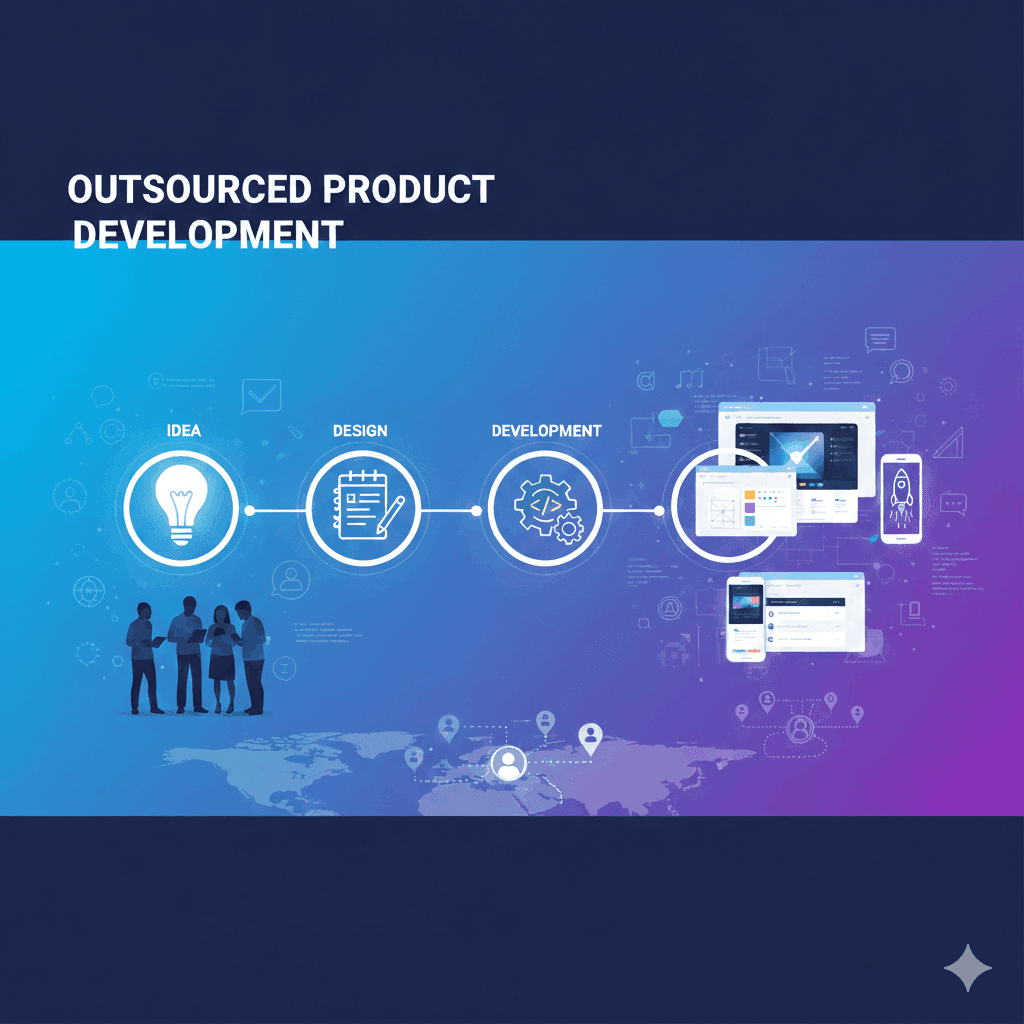
Outsourced Product Development: Complete 2026 Guide
Farhan K33 min read
AI & ML
Over 63% of successful tech products launched in 2025 leveraged outsourced software product development at some stage—from initial MVP to full-scale production. Yet many companies still struggle with the decision: should we build in-house or outsource product development? The answer increasingly favors outsourcing, not just for cost savings (though 50-70% reductions are common), but for speed to market, access to specialized expertise, and the ability to focus internal resources on core business strategy.
If you're considering outsourced product development services for your next software product, you're evaluating one of the most strategic decisions for your business. The right outsourcing partner doesn't just write code—they become your product development team, contributing to strategy, user experience, architecture, and go-to-market execution.
This comprehensive guide draws from analysis of 400+ successful outsourced product development projects across SaaS, mobile, web platforms, and enterprise software. We'll cover everything you need to know: when outsourcing makes sense, how to choose the right partner, what the process looks like, realistic costs, and proven strategies for building products that succeed in market.
What is Outsourced Software Product Development?
Outsourced software product development refers to partnering with external development teams to design, build, launch, and often maintain complete software products from concept through market release and beyond. Unlike staff augmentation (where you hire individual contractors) or project-based development (building a specific feature), outsourced product development means delegating end-to-end product responsibility to an external team.
This encompasses the entire product lifecycle:
Product Strategy and Planning:
- Market research and competitive analysis
- User persona development and needs assessment
- Feature prioritization and roadmap planning
- Technical feasibility evaluation
- MVP (Minimum Viable Product) scoping
Design and User Experience:
- User flow mapping and information architecture
- Wireframing and prototyping
- Visual design and brand integration
- Usability testing and iteration
- Design system creation
Development and Engineering:
- Full-stack development (frontend, backend, database)
- API development and third-party integrations
- Cloud infrastructure setup and DevOps
- Quality assurance and testing
- Performance optimization
Launch and Market Introduction:
- Beta testing programs
- App store submissions (for mobile products)
- Launch strategy support
- Initial user onboarding optimization
- Analytics implementation
Post-Launch Growth:
- Feature iterations based on user feedback
- Scaling infrastructure as user base grows
- Ongoing maintenance and bug fixes
- New feature development
- Platform expansion
How Outsourced Product Development Differs from Traditional Outsourcing
Traditional software outsourcing often means "we need X built, here are detailed specifications, please code it." Outsourced product development is fundamentally different:
Traditional Outsourcing:
- You define detailed requirements
- External team executes to spec
- Limited strategic input
- Fixed scope, time, and budget
- Success = delivered as specified
Outsourced Product Development:
- Collaborative requirement definition
- External team contributes product thinking
- Strategic partnership on what to build
- Flexible scope based on learning and market feedback
- Success = product achieves market goals
The best outsourced product development partners act as your extended product team, not just code factories. They challenge assumptions, suggest better approaches, and care about your product's market success—not just completing assigned tasks.
Why Outsourced Product Development Works
Product development outsourcing has matured significantly over the past decade. Several factors make it increasingly viable:
Product development methodologies are universal: Agile, Scrum, Lean Startup, Design Thinking—these frameworks work identically whether teams are co-located or distributed. Tools like Figma, Jira, GitHub, and Slack enable seamless collaboration.
Remote work normalization: The 2020-2025 remote work shift proved distributed teams can build complex products successfully. Geographic proximity no longer determines collaboration quality.
Specialized expertise accessibility: Building a modern software product requires expertise in UX design, frontend frameworks (React, Vue), backend systems (Node.js, Python), cloud infrastructure (AWS, Google Cloud), mobile development (iOS, Android), and more. Outsourced product development teams have these specializations already assembled.
Speed and focus advantages: Outsourcing lets you move faster (no hiring delays) while keeping internal teams focused on business strategy, sales, customer success, and market positioning rather than engineering details.
According to Deloitte's 2025 Global Outsourcing Survey, 71% of companies now view outsourced product development as a strategic differentiator rather than just a cost-saving measure—marking a fundamental shift in how outsourcing is perceived and utilized.
Key Benefits of Outsourced Product Development
Faster Time-to-Market: Launch 50-70% Quicker
Speed often determines success in competitive markets. Outsourced product development accelerates your timeline dramatically:
Eliminate Hiring Delays:
- Domestic hiring: 3-6 months to build a 5-person team (recruiting, interviewing, negotiating, onboarding)
- Outsourced team: 2-4 weeks to start with experienced team
- Time saved: 10-20 weeks before first line of code
Parallel Workstreams:
- Design and backend architecture happen simultaneously
- Multiple developers work on different features in parallel
- Dedicated QA team tests as features complete (no waiting for development to finish)
Focused Execution:
- External team works exclusively on your product (no internal meetings, company initiatives, distractions)
- Proven processes eliminate common first-time product development mistakes
- Experience with similar products means avoiding known pitfalls
One fintech startup needed to launch before a competitor's expected release (8-month window). Their outsourced product development team in Eastern Europe delivered a fully functional MVP in 5 months—3 months faster than projected with an internal team—enabling them to capture market share first.
Cost Efficiency: 50-70% Savings vs In-House Teams
The economics of outsourced software product development are compelling for both startups and enterprises:
Direct Cost Comparison (6-Month Product Development):
In-House Team (US):
- Product Manager: $120,000/year ÷ 2 = $60,000
- Senior Full-Stack Developer: $140,000/year ÷ 2 = $70,000
- Frontend Developer: $110,000/year ÷ 2 = $55,000
- UI/UX Designer: $100,000/year ÷ 2 = $50,000
- QA Engineer: $85,000/year ÷ 2 = $42,500
- Total: $277,500
Outsourced Team:
- Full team (PM, 2 developers, designer, QA): $35-$55/hour blended
- 6 months × 4 weeks × 40 hours × $45/hour = $43,200 per team member
- 5 team members = $216,000
- Total: $110,000-$150,000
Net Savings: $127,500-$167,500 (46-60% reduction)
Hidden Savings:
- No recruitment costs ($15k-$30k saved)
- No benefits, payroll taxes, equipment ($50k-$70k saved)
- No office space for additional headcount ($10k-$20k saved)
- No severance if project ends or pivots ($20k-$50k risk eliminated)
Total True Savings: Often exceeds 65% when all factors included
Access to Specialized Product Development Expertise
Modern software products require diverse, specialized skills. Outsourced product development gives you a complete team:
Product Strategy and UX:
- Product managers with successful product launches
- UX researchers who understand user behavior
- UI designers skilled in modern design systems
- Growth experts who understand product-market fit
Technical Expertise:
- Frontend specialists (React, Vue, Angular, mobile frameworks)
- Backend architects (microservices, APIs, databases)
- DevOps engineers (CI/CD, cloud infrastructure, scaling)
- Data engineers (analytics, data pipelines, ML integration)
Industry-Specific Knowledge:
- Fintech: Payment processing, compliance, security
- Healthcare: HIPAA compliance, EHR integration, telemedicine
- E-commerce: Inventory systems, payment gateways, fulfillment
- SaaS: Multi-tenancy, subscription billing, onboarding flows
One healthcare startup needed to build a HIPAA-compliant telemedicine platform. Their outsourced product development partner in Poland had previously built 3 similar platforms—bringing expertise in secure video streaming, EHR integration, and healthcare compliance that would have taken an internal team months to develop.
Focus on Core Business While Experts Build Product
Outsourcing product development frees your internal team for strategic work:
Your Team Focuses On:
- Market positioning and go-to-market strategy
- Customer acquisition and sales
- Fundraising and investor relations
- Business partnerships and channel development
- Customer success and support infrastructure
Outsourced Team Handles:
- All technical implementation details
- Design and user experience decisions
- Quality assurance and testing
- Infrastructure and DevOps
- Technical documentation
This division of labor is especially powerful for non-technical founders or businesses entering new product categories where internal teams lack relevant experience.
Flexibility to Scale Team and Pivot Quickly
Product development is inherently uncertain. Outsourcing provides flexibility in-house teams can't match:
Scale Up Rapidly:
- Need 3 more developers to hit a launch deadline? Add them in 1-2 weeks
- Requires specialized expertise temporarily? Bring in experts for specific sprints
- Expanding to new platforms? Add mobile team without recruiting
Scale Down Without Consequences:
- Product launch complete? Reduce team to maintenance mode (1-2 developers)
- Pivot required? Restructure team composition without layoffs
- Funding delayed? Pause development temporarily without employment commitments
Technology Flexibility:
- Decide to switch from web to mobile-first? Partner has both capabilities
- Need to add blockchain integration? They can source that expertise
- Switching cloud providers? DevOps team handles migration
A SaaS startup raised Series A and needed to scale from MVP (2 developers) to production product (8 developers) in 6 weeks. Their outsourced product development partner scaled the team immediately—impossible with domestic hiring timelines.
Reduced Risk and Faster Learning
Outsourced product development teams have built products before. You benefit from their experience:
Avoid Common Mistakes:
- Poor technical architecture (scaling problems, technical debt)
- Over-engineering MVP (wasted time on unnecessary features)
- Inadequate testing (launching with critical bugs)
- Wrong technology choices (locked into outdated stacks)
Leverage Best Practices:
- Proven development processes (Agile, CI/CD, code reviews)
- Established design patterns and component libraries
- Security and compliance frameworks
- Performance optimization techniques
Learn What Works:
- A/B testing strategies for product features
- User onboarding patterns that drive retention
- Analytics implementation for product insights
- Iteration frameworks based on user feedback
💡 Pro Tip: The best outsourced product development partners share their learnings transparently. They'll tell you "we tried this approach on a similar product and it failed—here's what worked instead." This institutional knowledge is invaluable.

When to Choose Outsourced Product Development
Outsourcing product development isn't always the right choice. Here's when it makes sense:
1. You're Building Your First Software Product
Why Outsource:
- You lack internal technical expertise to build software products
- You don't know what "good" looks like (architecture, UX, testing)
- Hiring a complete team is too risky before product validation
- You need guidance on technology choices and development processes
What to Outsource:
- Everything—strategy, design, development, testing, launch
- Partner should act as your technical co-founder
- Look for partners experienced with first-time founders
Example: A consumer brand wanted to launch a mobile shopping app but had zero software development experience. Their outsourced product development partner guided them through the entire process—from app concept to App Store launch—educating them along the way about mobile development realities.
2. You Need to Launch an MVP Quickly
Why Outsource:
- Speed is critical (competitive timing, fundraising deadline, market window)
- MVP development is time-boxed (3-6 months typical)
- You want to validate product-market fit before building internal team
- Outsourced teams can start immediately vs 3-6 month hiring timeline
What to Outsource:
- MVP design and development
- Core feature set only (ruthlessly prioritized)
- Basic analytics and user feedback mechanisms
- Initial launch and iteration
Example: A marketplace startup needed an MVP in 4 months to present at demo day for investor funding. Their outsourced team delivered a working two-sided marketplace with payment processing, reviews, and mobile apps—securing $2M seed funding.
3. Your Internal Team Lacks Specific Expertise
Why Outsource:
- You need specialized skills (mobile development, ML/AI, blockchain)
- Internal team is web-focused but product requires mobile apps
- You need modern tech stack experience (your team knows legacy technologies)
- Compliance expertise required (HIPAA, SOC2, GDPR)
What to Outsource:
- Specialized components (mobile apps, ML models, infrastructure)
- Entire product if gap is significant
- Temporary expertise (bring in specialists for specific phases)
Example: An enterprise software company with a .NET desktop application wanted to build a modern React-based web app. Their internal team had zero React experience. Outsourcing the entire web product allowed them to enter the market without retraining or replacing their existing team.
4. You're Entering a New Product Category
Why Outsource:
- Reduces risk of expensive experiments in unfamiliar territory
- Gets expertise specific to the new product type
- Allows validation before committing to full internal buildout
- Learns what's required to succeed in new category
What to Outsource:
- Initial product version to test market viability
- Specialized features unique to the category
- Technology stack experimentation and validation
Example: A B2B SaaS company wanted to add a mobile app to their product suite but had only built web applications. Outsourcing the mobile development allowed them to test mobile market demand without building an entirely new internal mobile team.
5. You Need to Scale Beyond Internal Capacity
Why Outsource:
- Product roadmap exceeds internal team bandwidth
- Market opportunities require faster feature delivery
- Seasonal or project-based scaling needs
- Geographic expansion requires 24/7 development
What to Outsource:
- Specific features or modules (keep core in-house)
- Entire platform expansions (e.g., iOS app when you have Android)
- Parallel product development (work on v2 while internal team maintains v1)
- Geographic-specific features (localization, regional compliance)
Example: A SaaS company's internal team was fully occupied maintaining existing product for current customers. Outsourcing development of their next-gen platform allowed them to innovate without neglecting existing users.
The Outsourced Product Development Process
Here's the proven end-to-end process for successful outsourced software product development:
Phase 1: Product Discovery and Strategy (2-4 Weeks)
Collaborative Activities:
- Market research and competitive analysis
- User persona development
- Problem validation (is this worth solving?)
- Solution brainstorming
- Feature prioritization using frameworks (MoSCoW, RICE, Kano)
- MVP scope definition
- Technical feasibility assessment
Your Role:
- Share business vision and goals
- Provide market and customer insights
- Participate in prioritization decisions
- Approve MVP scope
Outsourced Team Role:
- Conduct technical feasibility research
- Propose technology stack options
- Identify technical risks and dependencies
- Estimate effort and timeline
- Create product requirements document (PRD)
Deliverables:
- Product requirements document (PRD)
- User personas and journey maps
- MVP feature list (prioritized must-haves vs nice-to-haves)
- Technology stack recommendation
- High-level architecture proposal
- Project timeline and budget estimate
Success Factors:
- Be honest about constraints (budget, timeline, team availability)
- Challenge each other's assumptions productively
- Focus on user value, not feature lists
- Define success metrics upfront (what does "successful product" mean?)
Phase 2: UX/UI Design (3-6 Weeks)
Design Process:
- User flow mapping (how users accomplish key tasks)
- Information architecture (organizing content and features)
- Low-fidelity wireframes (structure without visual design)
- Interactive prototypes (clickable flows for testing)
- High-fidelity mockups (pixel-perfect designs)
- Design system creation (colors, typography, components, spacing)
Review Cadence:
- Week 1-2: Review and approve user flows and wireframes
- Week 3-4: Review initial visual design concepts
- Week 5-6: Review high-fidelity mockups and interactive prototype
Your Role:
- Provide brand guidelines (if existing) or preferences
- Review designs from user perspective (is this intuitive?)
- Gather stakeholder feedback
- Conduct user testing if possible
- Sign off on final designs before development
Outsourced Team Role:
- Propose design direction aligned with product goals
- Create designs following platform guidelines (if web/mobile)
- Iterate based on feedback
- Prepare developer handoff (design specs, assets, design system)
Deliverables:
- Complete user flows for all key scenarios
- Wireframes for all screens/pages
- Interactive prototype (Figma, InVision, or similar)
- High-fidelity mockups for all screens
- Design system documentation
- Asset library (icons, images, illustrations)
💡 Pro Tip: Invest heavily in the design phase. Changes during design cost hours; changes during development cost days or weeks. Getting design right prevents expensive development rework.
Phase 3: MVP Development (8-16 Weeks)
Development Structure:
- 2-week sprints (typical)
- Sprint planning (define sprint goals and stories)
- Daily standups (async or brief video check-ins)
- Development and coding
- Code reviews and quality checks
- Sprint review/demo (show working features)
- Sprint retrospective (continuous improvement)
Technology Implementation:
- Frontend development (web or mobile UI)
- Backend development (APIs, business logic, database)
- Third-party integrations (payments, auth, analytics)
- Cloud infrastructure setup
- CI/CD pipeline implementation
- Automated testing infrastructure
Communication Rhythm:
- Daily: Async status updates in Slack/Teams
- Weekly: Sprint demos showing working features
- Bi-weekly: Sprint planning and retrospectives
- Ad-hoc: Quick sync calls for complex discussions
Your Role:
- Review sprint demos and provide feedback
- Test builds regularly (weekly minimum)
- Make timely decisions when trade-offs arise
- Participate in user acceptance testing (UAT)
- Prioritize bug fixes vs. new features
Outsourced Team Role:
- Build features according to designs and requirements
- Conduct code reviews and maintain quality
- Test features as they're completed
- Deploy to staging environment for your review
- Document code and technical decisions
Deliverables:
- Working software (deployed to staging environment)
- Regular builds for testing (weekly or bi-weekly)
- Source code (committed to your repository)
- Technical documentation
- API documentation (if applicable)
- Test coverage reports
Phase 4: Quality Assurance and Testing (2-4 Weeks, Parallel)
QA Activities:
- Functional testing (does it work as specified?)
- User acceptance testing (does it meet user needs?)
- Cross-browser/device testing (works everywhere?)
- Performance testing (fast enough?)
- Security testing (vulnerabilities identified?)
- Usability testing (is it intuitive?)
Testing Types:
- Manual testing by QA team
- Automated regression testing
- Beta testing with real users
- Load/stress testing for scalability
- Penetration testing for security
Bug Management:
- Severity classification (critical, high, medium, low)
- Prioritization (must-fix before launch vs. can wait)
- Regression testing after fixes
- Retesting until quality bar met
Deliverables:
- Test plan and test cases
- Bug reports and fix verification
- Performance benchmarks
- Security audit report
- UAT signoff documentation
Phase 5: Launch and Deployment (1-2 Weeks)
Pre-Launch Checklist:
- Final round of testing on production environment
- Performance optimization and monitoring setup
- Security final review
- Backup and disaster recovery procedures
- Analytics and tracking implementation
- Error monitoring and logging (Sentry, LogRocket)
- Documentation for users and support team
Launch Activities:
- Production deployment
- DNS and domain configuration
- SSL certificate setup
- App store submission (if mobile)
- Monitoring and alerting configuration
- Launch communication to users
Post-Launch Immediate:
- Monitor error rates and performance
- Hotfix critical issues immediately
- Gather initial user feedback
- Track key metrics (signups, activation, engagement)
- Triage bug reports and feature requests
Deliverables:
- Deployed production application
- Monitoring dashboards
- Launch documentation
- Support runbook (how to handle common issues)
- Handoff documentation (if transitioning to internal team)
Phase 6: Post-Launch Iteration and Growth (Ongoing)
Continuous Improvement:
- Analyze user behavior and feedback
- Prioritize enhancements and new features
- Fix bugs reported by users
- Optimize performance based on real usage
- A/B test feature variations
- Scale infrastructure as users grow
Ongoing Activities:
- Regular feature releases (monthly or quarterly)
- Performance monitoring and optimization
- Security updates and patches
- User feedback integration into roadmap
- Technical debt management
Transition Options:
- Continue with outsourced team for ongoing development
- Gradually transition to internal team with outsourced support
- Maintain outsourced team for specific features/platforms
- Reduce to maintenance-only engagement

Choosing the Right Outsourced Product Development Partner
Selecting your partner is the most critical decision. Here's how to evaluate:
Essential Evaluation Criteria
1. Product Development Track Record
What to Request:
- 5-10 complete product case studies (not just features)
- Products they've taken from concept to market
- Metrics: time to launch, user growth, business outcomes
- Products that have raised funding or been acquired
- Long-term client relationships (3+ years)
Red Flags:
- Only project-based work (never owned full product lifecycle)
- Can't show live, successful products
- No metrics or outcomes, only technical descriptions
- High client churn (relationships end after project completion)
Green Flags:
- Multiple products with 10,000+ users
- Products that secured funding after launch
- Clients who expanded engagement after initial product
- Mix of startup and enterprise product experience
2. Product Thinking and Strategic Capability
Assess During Discovery:
- Do they ask "why" questions about your product goals?
- Do they challenge requirements thoughtfully?
- Do they suggest features you haven't considered?
- Do they think about user value, not just technical implementation?
- Can they articulate product strategy frameworks (Jobs to Be Done, Value Proposition Canvas)?
Questions to Ask:
- "Tell me about a time you advised a client against a feature they wanted. What happened?"
- "How do you approach MVP scoping and prioritization?"
- "What's your process for validating product-market fit?"
- "How do you balance user needs with business goals?"
Must-Haves:
- Product manager who's launched products (not just project manager)
- Strategic thinking during initial conversations
- Frameworks for prioritization and decision-making
- User-centric approach to feature development
3. Design and UX Capabilities
Evaluate Design Portfolio:
- Modern, professional design aesthetic
- User flows that make sense (logical navigation)
- Platform-appropriate design (web vs mobile conventions)
- Design systems and component libraries
- Responsive design across devices
Design Process Assessment:
- Do they do user research and testing?
- How do they approach information architecture?
- Do they create interactive prototypes before development?
- Do they follow accessibility best practices?
- Can they articulate design decisions (not just "it looks good")?
Team Structure:
- Dedicated UX researchers (not just visual designers)
- UI designers skilled in modern tools (Figma, Sketch)
- Separate UX and UI roles (specialization matters)
- Design system expertise
4. Technical Excellence and Engineering Practices
Technology Stack Expertise:
- Modern frameworks and languages (not outdated tech)
- Cloud-native architecture (AWS, Google Cloud, Azure)
- Mobile development (iOS, Android, React Native, Flutter)
- DevOps and CI/CD capabilities
- Scalability and performance engineering
Engineering Practices:
- Code reviews standard practice
- Automated testing (unit, integration, e2e)
- Version control (Git) and branching strategies
- Documentation standards
- Security best practices
Questions to Ask:
- "What's your approach to technical architecture for MVPs?"
- "How do you ensure code quality?"
- "What's your testing strategy?"
- "How do you handle technical debt?"
- "What's your experience scaling products from 100 to 100,000 users?"
5. Communication and Cultural Fit
Communication Assessment:
- Response time to initial inquiry (within 24-48 hours)
- Clarity of written communication
- Video call comfort and professionalism
- English proficiency (if language barrier concern)
- Proactive communication style
Cultural Compatibility:
- Work style (hierarchical vs. collaborative)
- Feedback approach (direct vs. indirect)
- Problem-solving approach (tell problems early vs. try to solve first)
- Decision-making speed (move fast vs. thorough analysis)
Time Zone Management:
- Overlap hours available
- Flexibility for critical meetings
- Async communication practices
- Previous experience with clients in your geography
Vetting Process: 5-Step Framework
✅ Step 1: Research and Shortlist (Week 1)
- Search platforms: Clutch, GoodFirms, Upwork for product development firms
- Review company websites and portfolios
- Check case studies for product development (not just projects)
- Read client reviews focusing on product launches
- Shortlist 5-7 potential partners
✅ Step 2: Initial Contact and RFP (Week 1-2)
- Send product brief and RFP to shortlist
- Evaluate response quality and speed
- Assess questions they ask (do they understand product development?)
- Review initial proposals
- Shortlist 3-4 for deep evaluation
✅ Step 3: Deep Discovery Calls (Week 2-3)
- Schedule 60-90 minute video calls
- Present product concept, discuss their approach
- Evaluate product thinking and strategic input
- Review team profiles (who would actually work on project)
- Discuss process, communication, and tools
- Request detailed proposals with timelines and costs
✅ Step 4: Reference Checks (Week 3-4)
- Speak with 2-3 previous clients (request references)
- Ask: "What went well? What didn't? Would you hire them again?"
- Focus on product outcomes (not just project completion)
- Inquire about communication, responsiveness, strategic value
- Shortlist 1-2 final candidates
✅ Step 5: Pilot Project or Kickoff (Week 4-6)
- Option A: Paid discovery/design pilot (2-4 weeks, $5k-$15k)
- Option B: Proceed to full product development with preferred partner
- Finalize contract (IP ownership, payment terms, SLAs)
- Establish communication protocols and tools
- Conduct formal kickoff with full team
💡 Pro Tip: The paid pilot approach (Option A) significantly reduces risk. You invest $5k-$15k to test the partnership before committing to $100k+ product development. Many successful long-term partnerships start with small pilots.
Outsourced Product Development Costs: Realistic Budgets
Understanding true costs helps you budget accurately:
Cost Breakdown by Product Complexity
Simple MVP (3 Months)
Product Type: Basic web app or mobile app with standard features Examples: Content platform, simple booking app, basic SaaS tool Team: 1 PM, 1 designer, 2 developers, 0.5 QA
Outsourced Development Cost:
- Discovery & Strategy: $8,000-$12,000
- UX/UI Design: $10,000-$15,000
- MVP Development: $45,000-$65,000
- QA & Testing: $5,000-$8,000
- Launch Support: $3,000-$5,000
- Total: $71,000-$105,000
US In-House Cost Comparison: $180,000-$250,000 Savings: 55-65%
Medium Complexity Product (6 Months)
Product Type: Multi-featured web/mobile platform Examples: Marketplace, social platform, e-commerce site, SaaS with integrations Team: 1 PM, 1-2 designers, 3-4 developers, 1 QA
Outsourced Development Cost:
- Discovery & Strategy: $12,000-$18,000
- UX/UI Design: $20,000-$30,000
- MVP Development: $90,000-$140,000
- Advanced Features: $30,000-$50,000
- QA & Testing: $15,000-$25,000
- Launch Support: $5,000-$10,000
- Total: $172,000-$273,000
US In-House Cost Comparison: $380,000-$550,000 Savings: 50-60%
Complex Enterprise Product (12 Months)
Product Type: Enterprise SaaS, fintech platform, healthcare system Examples: Multi-tenant SaaS, payment platform, telemedicine system Team: 1-2 PMs, 2 designers, 5-8 developers, 2 QA, DevOps engineer
Outsourced Development Cost:
- Discovery & Strategy: $20,000-$35,000
- UX/UI Design: $40,000-$60,000
- MVP Development: $150,000-$220,000
- Advanced Features & Scaling: $100,000-$180,000
- Security & Compliance: $25,000-$40,000
- QA & Testing: $35,000-$55,000
- Launch Support: $10,000-$15,000
- Total: $380,000-$605,000
US In-House Cost Comparison: $850,000-$1,400,000 Savings: 50-60%
Cost Factors That Impact Pricing
Geographic Location:
- Eastern Europe: $40-$70/hour (Poland, Ukraine, Romania)
- Latin America: $35-$60/hour (Mexico, Argentina, Colombia)
- India: $25-$45/hour (Bangalore, Pune, Hyderabad)
- Southeast Asia: $30-$50/hour (Vietnam, Philippines)
Team Seniority:
- Junior/Mid-level: $25-$40/hour
- Senior developers: $45-$65/hour
- Architects and specialists: $70-$100/hour
- Design leads: $50-$80/hour
Product Complexity:
- Standard web/mobile app: Base rates
- Real-time features (chat, notifications): +15-25%
- Payment processing: +10-20%
- Healthcare/fintech compliance: +20-35%
- AI/ML integration: +25-40%
- Blockchain: +30-50%
Engagement Model:
- Fixed price (MVP with clear scope): Often 10-15% premium for risk
- Time & materials (flexible scope): Standard hourly rates
- Dedicated team (ongoing product): Discounted rates (10-20% lower)
Hidden Costs to Budget For
Infrastructure and Tools:
- Cloud hosting (AWS, Google Cloud): $200-$2,000/month
- CI/CD and DevOps tools: $100-$500/month
- Project management (Jira, Linear): $50-$200/month
- Design tools (Figma, Adobe): $50-$150/month
- Analytics and monitoring: $100-$500/month
Third-Party Services:
- Authentication (Auth0, Firebase): $0-$1,000/month
- Payment processing (Stripe, PayPal): Transaction fees
- Email services (SendGrid, Mailgun): $50-$500/month
- SMS/notifications: $100-$1,000/month
- Analytics (Mixpanel, Amplitude): $0-$1,500/month
Post-Launch Costs:
- Maintenance retainer: 15-25% of development cost annually
- Feature development: Ongoing budget based on roadmap
- Customer support: $3,000-$15,000/month
- Marketing and user acquisition: Variable
💡 Pro Tip: Budget 20-30% above quoted development costs for infrastructure, tools, and contingencies. A $100k development quote should have $120k-$130k total budget.

Common Challenges and How to Overcome Them
Outsourced product development presents specific challenges. Here's how to address them:
Challenge 1: Misalignment on Product Vision
Problem: Outsourced team builds what's specified but misses the "why" behind features, leading to technically correct but strategically wrong product.
Solutions:
- Invest in discovery: Spend 2-4 weeks on collaborative strategy before development
- Share the vision: Explain business goals, target users, market positioning—not just feature lists
- Regular strategic check-ins: Monthly "zoom out" discussions about product direction
- Include team in user research: Let developers and designers hear from actual users
- Measure outcomes: Define success metrics beyond "feature completed"
Example: A SaaS startup's outsourced team built exactly what was specified—but the onboarding flow had 12 steps users abandoned. When the team understood the business goal (maximize trial-to-paid conversion), they redesigned onboarding to 3 steps and conversion jumped 40%.
Challenge 2: Communication Gaps and Time Zones
Problem: Time zone differences create delays, misunderstandings compound over async communication, progress feels slow.
Solutions:
- Establish overlap hours: Minimum 2-3 hours daily for real-time communication
- Over-communicate async: Detailed written specs, video walkthroughs (Loom), comprehensive documentation
- Structured communication: Daily async updates, weekly video demos, bi-weekly planning
- Record meetings: Async team members watch recordings
- Use collaboration tools effectively: Slack for quick questions, Jira for detailed specs, Figma for design collaboration
Communication Protocol Example:
- Morning (your time): Review overnight progress, provide written feedback
- Overlap hours: Video calls for complex discussions, real-time problem-solving
- Afternoon (your time): Detailed specs and priorities for next day
- Their working hours: Development, questions via Slack, commits to repository
Challenge 3: Quality Control and Testing Gaps
Problem: Product feels buggy, edge cases missed, performance issues, inconsistent UX.
Solutions:
- Define quality standards upfront: Performance benchmarks, browser support, accessibility requirements
- Implement automated testing: Unit tests, integration tests, e2e tests (not just manual QA)
- Regular builds for testing: Weekly minimum (ideally daily with CI/CD)
- Beta testing program: Real users test before launch
- Code review requirements: All code reviewed before merging
- Performance monitoring: Tools like Lighthouse, WebPageTest, profiling
Quality Checklist:
- Automated test coverage >70%
- Manual testing across browsers and devices
- Performance benchmarks met (load time, responsiveness)
- Accessibility standards (WCAG 2.1 AA minimum)
- Security review completed
- Beta testing with 20-50 real users
- Error monitoring integrated (Sentry, Rollbar)
Challenge 4: Scope Creep and Budget Overruns
Problem: "Just one more feature" leads to timeline delays and budget overages.
Solutions:
- Fixed MVP scope: Define exactly what's in/out of initial product
- Change request process: Formal process for adding features (with cost/time impact)
- Prioritization framework: Use RICE, MoSCoW, or similar to evaluate new requests
- Time-boxed iterations: "We have 12 weeks; what's the best product we can build?"
- Build-measure-learn: Launch MVP, gather data, prioritize next features based on usage
Scope Management Process:
- New feature requested
- Evaluate: Is this essential for MVP or post-launch?
- If essential: What can we remove to maintain timeline?
- If post-launch: Add to backlog with priority
- Document decision and communicate to team
Challenge 5: Knowledge Transfer and Documentation
Problem: Product launches but no one understands how it works, making maintenance difficult.
Solutions:
- Documentation requirements: Code documentation, architecture diagrams, API documentation
- Knowledge transfer sessions: Video walkthroughs of codebase, architecture, key decisions
- Developer handbooks: Setup instructions, deployment procedures, troubleshooting guides
- Recorded demos: Video library of product features and how they work
- Transition period: Overlap between outsourced team and internal team (if transitioning)
Essential Documentation:
- Architecture overview and diagrams
- API documentation (endpoints, parameters, responses)
- Database schema and relationships
- Environment setup instructions
- Deployment procedures
- Troubleshooting common issues
- Third-party integrations and credentials
- Performance optimization techniques used
Real-World Success Story: SaaS Platform Launch
Company: B2B SaaS startup (project management software) Challenge: Build complete product from scratch, launch in 8 months for Series A funding Budget: $250,000 total product development budget Timeline: 8 months from kickoff to public launch
Initial Situation
Two non-technical co-founders had identified a gap in project management software for creative agencies. They had $250k budget (pre-seed funding) to build an MVP, validate product-market fit, and use success to raise Series A.
Hiring an internal team would consume the entire budget in salaries alone (5 people × $110k average × 8 months = $365k) before writing a single line of code. Outsourced product development was the only viable path.
Partner Selection
After evaluating 6 outsourced product development companies, they chose a team in Poland based on:
- Strong SaaS product portfolio (4 successful SaaS products launched)
- Experience with project management tools (understood domain)
- Product-focused approach (challenged requirements, suggested improvements)
- Excellent English and communication (team lead educated in UK)
- Competitive pricing ($45/hour blended vs $55-65 from other finalists)
Team Composition and Approach
Outsourced Team:
- 1 Product Manager
- 1 Senior UX/UI Designer
- 2 Senior Full-Stack Developers (React + Node.js)
- 1 Frontend Developer (React specialist)
- 1 QA Engineer
- 1 DevOps Engineer (part-time for infrastructure)
Technology Stack:
- Frontend: React, TypeScript, Material-UI
- Backend: Node.js, Express, PostgreSQL
- Infrastructure: AWS (ECS, RDS, S3, CloudFront)
- Tools: Jira, Figma, GitHub, Slack
Development Timeline
Month 1-2: Discovery and Design
- Product strategy workshops (remote, 4 sessions)
- Competitive analysis and user research
- MVP feature prioritization (started with 42 features, reduced to 18 must-haves)
- Full UX/UI design (35 screens)
- Interactive prototype for user testing
Month 3-6: MVP Development
- Four 2-week sprints building core features
- Weekly demos every Friday (noon EST / 6pm Poland time)
- Bi-weekly user testing with beta users (recruited by co-founders)
- Continuous deployment to staging for founder testing
Month 7: Beta Testing and Refinement
- Private beta with 50 agencies (co-founders' network)
- Bug fixing and performance optimization
- Feature refinement based on feedback
- Documentation and onboarding flow improvements
Month 8: Launch Preparation and Public Release
- Security audit
- Performance optimization (page load <2 seconds)
- Analytics and monitoring setup
- Public launch marketing campaign
- App available on web and as Chrome extension
Results
Successful Product Launch:
- Launched on schedule (8 months from kickoff)
- 500 signups in first month (seeded from beta users)
- 4.6/5 product rating on Product Hunt
- 68% trial-to-paid conversion rate (industry average ~20%)
- Zero critical bugs post-launch
Business Impact:
- Product success enabled Series A raise ($3.5M, 2 months after launch)
- Continued partnership with Polish team for 18 months post-launch
- Grew to 5,000+ paying customers in year 1
- Eventually hired internal team but kept outsourced team for specialized projects
Total Investment:
- Product development: $238,000
- Infrastructure and tools: $12,000
- Total: $250,000 (on budget)
vs. In-House Alternative:
- Estimated cost: $450,000-$550,000 (salaries, recruiting, benefits, equipment)
- Timeline: 12-14 months (including 3-4 months hiring)
- Savings: $200k-$300k and 4-6 months time
Key Success Factors
What Worked:
- Ruthless MVP scoping: 18 must-have features (rejected 24 nice-to-haves for v2)
- Weekly demos: Seeing working product every week kept momentum and alignment
- Beta user involvement: 50 real users testing continuously improved product quality
- Product manager value: Polish PM acted as strategic partner, not just task manager
- Founder availability: Both founders dedicated 15-20 hours/week to product (feedback, testing, decisions)
- Design investment: 8 weeks of design prevented development rework
Challenges Overcome:
- Feature creep: Resisted adding features mid-development, captured in backlog instead
- Time zone management: Established 12pm-3pm EST as sacred overlap hours for meetings
- Technical debt decisions: Accepted some shortcuts for MVP launch, documented for later refactoring
Co-Founder Advice
CEO: "Outsourcing product development let us compete with better-funded competitors who had large engineering teams. The key was treating our outsourced team as partners, not vendors. We involved them in strategy, listened to their technical advice, and made fast decisions when they needed input. They cared about our success because we showed we valued their expertise beyond just code execution."
CTO (hired post-launch): "The product was well-architected and documented. When I joined 9 months after launch to build an internal team, I could understand the codebase quickly. The Polish team did proper engineering—not shortcuts or hacks. We still work with them for specialized projects like our mobile app because they know the product so well."

Key Takeaways: Outsourced Product Development in 2026
✅ Outsourcing accelerates time-to-market: Launch 50-70% faster by eliminating hiring delays and leveraging experienced teams with proven processes.
✅ Cost savings are substantial but not the only benefit: Save 50-70% on development costs, but the real value is accessing complete product teams (strategy, design, development, QA) you couldn't build internally.
✅ Choose partners for product thinking, not just coding: The best outsourced product development partners act as strategic partners who challenge assumptions, suggest improvements, and care about product success.
✅ Invest in discovery and design: Spending 25-30% of timeline on strategy and design prevents expensive development rework and leads to better products.
✅ Communication determines success: Establish overlap hours, over-communicate in writing, conduct regular demos, and maintain transparency on both sides.
✅ Quality requires process and standards: Define quality requirements upfront, implement automated testing, conduct regular UAT, and don't skip beta testing.
✅ Flexibility is a key advantage: Scale teams up or down based on needs, pivot without employment commitments, and access specialized expertise temporarily.
✅ Plan for long-term partnership: The best outcomes come from ongoing relationships where outsourced teams evolve the product post-launch, not just build-and-handoff.
Next Steps: Starting Your Outsourced Product Development Project
Ready to build your product with an outsourced development team?
Immediate Action Steps:
Week 1-2: Define Your Product
- Document your product vision and business goals
- Identify target users and their key problems
- Create initial feature wish list (will be prioritized later)
- Define success metrics (users, revenue, engagement)
- Establish budget range and timeline constraints
Week 2-3: Research and Shortlist Partners
- Identify 5-8 potential outsourced product development partners
- Review portfolios for similar products launched
- Check client testimonials and case studies
- Shortlist 3-4 based on product development experience
Week 3-4: Conduct Partner Evaluation
- Send product brief to shortlisted partners
- Conduct discovery calls (assess product thinking)
- Review detailed proposals and timelines
- Check references from previous product clients
- Select preferred partner
Week 5-6: Kickoff Discovery or Pilot
- Option A: Run paid discovery phase (2-4 weeks, $8k-$15k)
- Option B: Proceed to full product development
- Finalize contract (IP ownership, payment terms)
- Establish communication tools and protocols
- Conduct formal kickoff workshop
Resources to Download:
- Product Development RFP Template
- Partner Evaluation Scorecard for Product Development
- MVP Feature Prioritization Framework
- Product Requirements Document Template
- Launch Checklist for New Products
Talk to iTenX:
iTenX specializes in connecting companies with world-class outsourced product development teams. We've successfully launched 150+ products across SaaS, mobile, e-commerce, and fintech—from initial concept to market success.
Whether you're a first-time founder building your inaugural product or an enterprise entering a new product category, we'll help you:
- Choose the right technology stack and architecture
- Select the optimal outsourced team from our vetted network
- Scope your MVP and avoid common first-product mistakes
- Manage the entire development process from strategy to launch
- Establish processes for ongoing product iteration and growth
Schedule a free product strategy consultation to discuss your product vision, or explore our outsourced product development services.
Frequently Asked Questions
Q: How is outsourced product development different from just hiring offshore developers? A: Staff augmentation (hiring individual developers) means you manage them, define all tasks, and make all decisions. Outsourced product development means delegating end-to-end product responsibility—the partner contributes strategy, owns execution, and shares accountability for product success. You get a complete team (PM, design, dev, QA) rather than just coders.
Q: How long does outsourced product development take? A: Simple MVP: 3-4 months. Medium complexity product: 6-8 months. Complex enterprise product: 10-14 months. Timeline depends on product scope, complexity, and how quickly decisions are made. Most products launch in 4-8 month range.
Q: What if I don't have detailed requirements or mockups? A: That's expected and actually preferred. The best outsourced product development starts with discovery—collaboratively defining requirements, prioritizing features, creating designs. You bring business vision and market knowledge; they bring product and technical expertise. Together you define what to build.
Q: How do I protect my product idea when outsourcing? A: Use strong legal contracts (NDA, IP assignment ensuring all work is your property). Work with established companies (reputation matters to them). Use code repositories you control from day one. Consider filing provisional patents if truly novel. Reality: ideas matter less than execution—outsourcing accelerates execution.
Q: Can I start outsourced and transition to internal team later? A: Absolutely common. Many companies: (1) Build MVP outsourced, (2) Validate product-market fit, (3) Raise funding, (4) Hire internal team, (5) Keep outsourced team for specific platforms or features. Ensure contract allows this flexibility and includes knowledge transfer.
Q: What if the product doesn't work or fails in market? A: Product failure is usually market fit, not execution. Outsourced product development can't guarantee market success—that depends on solving real problems for real users. What outsourcing does: deliver working products faster and cheaper, enabling market testing without large internal team investment.
Q: How involved do I need to be during development? A: Weekly involvement minimum: review sprint demos, test builds, make decisions. Daily involvement ideal for first-time products: provide feedback, answer questions, test features. Budget 10-20 hours/week for engaged product ownership. Your involvement quality directly impacts product quality.
Q: What happens after product launch? A: Most companies continue with outsourced team for ongoing development (new features, optimizations). Typical post-launch: reduce team size to maintenance level (1-2 developers) or continue full team for rapid feature development based on user feedback. Many outsourced relationships last 2-5+ years as products evolve.
Conclusion: Build Better Products Through Outsourcing
Outsourced software product development has evolved from a cost-saving tactic to a strategic advantage. The combination of faster time-to-market, complete specialized teams, and significant cost savings enables companies to compete in ways that weren't possible with internal-only development.
The most successful products built through outsourcing share common elements: ruthless MVP scoping, strong collaborative partnerships, regular communication and demos, investment in design and strategy upfront, and treating outsourced teams as partners rather than vendors.
Whether you're a startup building your first product or an established company entering new markets, outsourced product development provides access to expertise and execution capacity that would take months or years to build internally—if you could build it at all.
The question isn't whether to outsource product development, but how to do it successfully. Choose partners who think like product people, invest in discovery before development, maintain strong communication rhythms, define quality standards upfront, and remember that product success comes from solving real user problems—not just delivering features.
Ready to transform your product vision into market reality? iTenX connects you with world-class outsourced product development teams who have proven track records turning concepts into successful products.
Schedule a free consultation | Explore outsourced development services
Have questions about outsourced product development? Share them in the comments. Have experience outsourcing products? Tell us what worked (or what you'd do differently).
Related Resources
- Nearshore vs Offshore Development: Complete Comparison
- How to Write a Product Requirements Document (PRD)
- MVP Development: What to Build First
- Choosing Technology Stack for Your Product
- Product-Market Fit: Validation Frameworks
- Software Development Cost Calculator
- Agile Product Development Best Practices
- Post-Launch Product Growth Strategies